Written by Peter Rubin and Ben Knuth of National Wildlife Federation, in partnership with GLBW
In July, the One Big Beautiful Bill Act (OBBBA) codified additional conservation funding supplied by the 2022 Inflation Reduction Act (IRA) into long term Farm Bill baseline funding. Through 2031, Natural Resources Conservation Services (NRCS) programs will receive an additional $10.7 billion in funding for voluntary incentive-based conservation programs like Conservation Ste wardship Program (CSP) and Environmental Quality Incentives Program (EQIP). These programs provide technical assistance and cost share to farmers implementing conservation farming practices on their lands, like perennial grains, virtual fencing, and silvopasture, among many others.
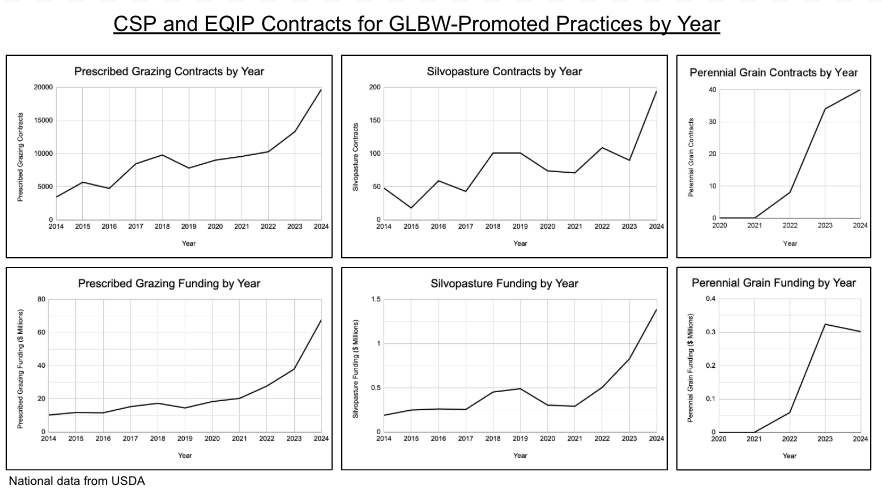
Green Lands Blue Waters (GLBW) aims to integrate more continuous living cover (CLC) on agricultural lands to support farm resilience, soil health, and water quality across the Upper Mississippi River Basin. Additional funding for NRCS programs is an opportunity for farmers to adopt more CLC practices. As CSP and EQIP have been oversubscribed for years, with less than half of nationwide applications funded in 2024, the added funding should help improve access and application success rate. In recent years, CSP and EQIP have been funding more contracts for perennial grain plantings, virtual fencing, and silvopasture, and the increase in funding should accelerate this trend.
Why GLBW supports these practices
Continuous living cover (CLC) keeps land covered with living vegetation throughout both growing and fallow seasons, improving soil quality, limiting erosion, and reducing input needs. GLBW advocates for CLC through a variety of perennial crops and systems, such as agroforestry, perennial grains, livestock integration, and stacked practices which retain living vegetation and roots year round. We focus on the Upper Mississippi Basin region where intensive agriculture often leads to deleterious environmental effects, including nutrient runoff into the Mississippi River and downstream wildlife harms. CLC can improve environmental outcomes of agriculture in the region and land use efficiency, while offering risk reductions and economic resilience on farms.
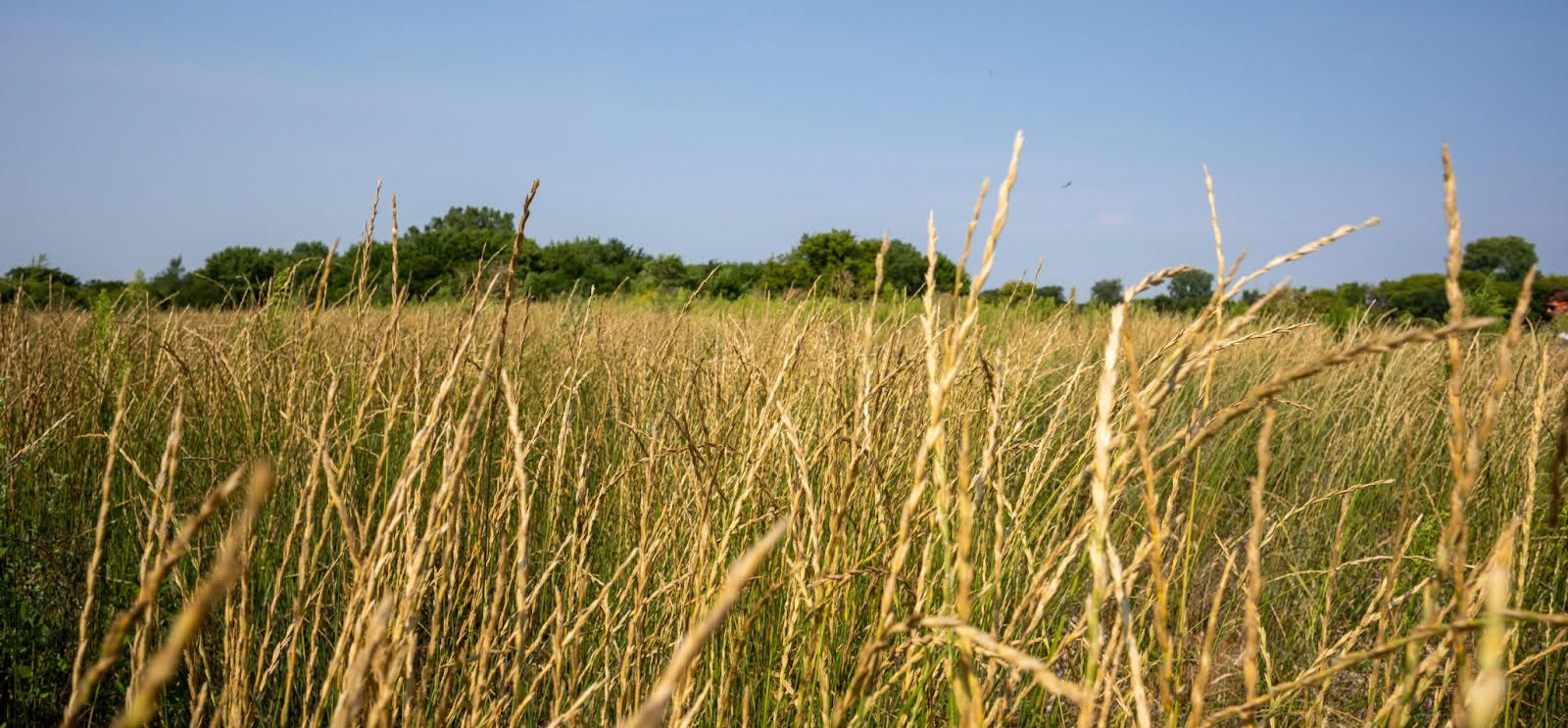
Perennial grains are a way to establish CLC in conventional row crop systems common in the Midwest. Perennials improve soil health while reducing labor costs and eliminating the need for annual plantings. One example is Kernza®- developed by The Land Institute and the University of Minnesota – a perennial grain currently commercially available. Producers looking to adopt perennial grains can apply for the E328O enhancement under CSP or EQIP, which provides cost share to those planting perennial grains for the first time. Since this incentive began in 2022, NRCS has obligated over $1.17 million in financial assistance to farmers, nearly half of which was obligated in FY2025 alone (see https://www.farmers.gov/data/financial-assistance-download). Note that these contracts are not only for Kernza, but also for first time plantings of alfalfa and other qualifying crops (alfalfa is included in the enhancement scenario even though not technically a grain). Note, $1.17 million is the total obligation on record since 2022, meaning dollars are obligated for spending over the lifetime of contracts of varying length; this is not equivalent to outlays, actual dollars spent per year. These payments are centralized in the Midwest, with consistent yearly participation across Illinois, Iowa, Michigan, and Minnesota. This is a popular option as NRCS contracts help farmers adopt new crops and practices while alleviating perceived risk to their operation. The upcoming increase in agency funding will encourage and support farmers looking to adopt perennial grains.
A combination of strong markets and governmental support is essential for encouraging widespread adoption. To that end, GLBW partners, such as The Land Institute, are creating market incentives to farmers through environmental certification standards on products using perennial grains. The Perennial Percent certification guarantees that 1% of grain incorporated in a product is Kernza, which has the potential to significantly increase demand for perennials. Other perennial grain supporting programs, such as the Audubon Bird Friendly Land certification, certify lands employing best practices– including perennial cover. Consumer awareness of and demand for environmental stewardship on farms can encourage manufacturers to procure perennial grains, possibly at a premium.
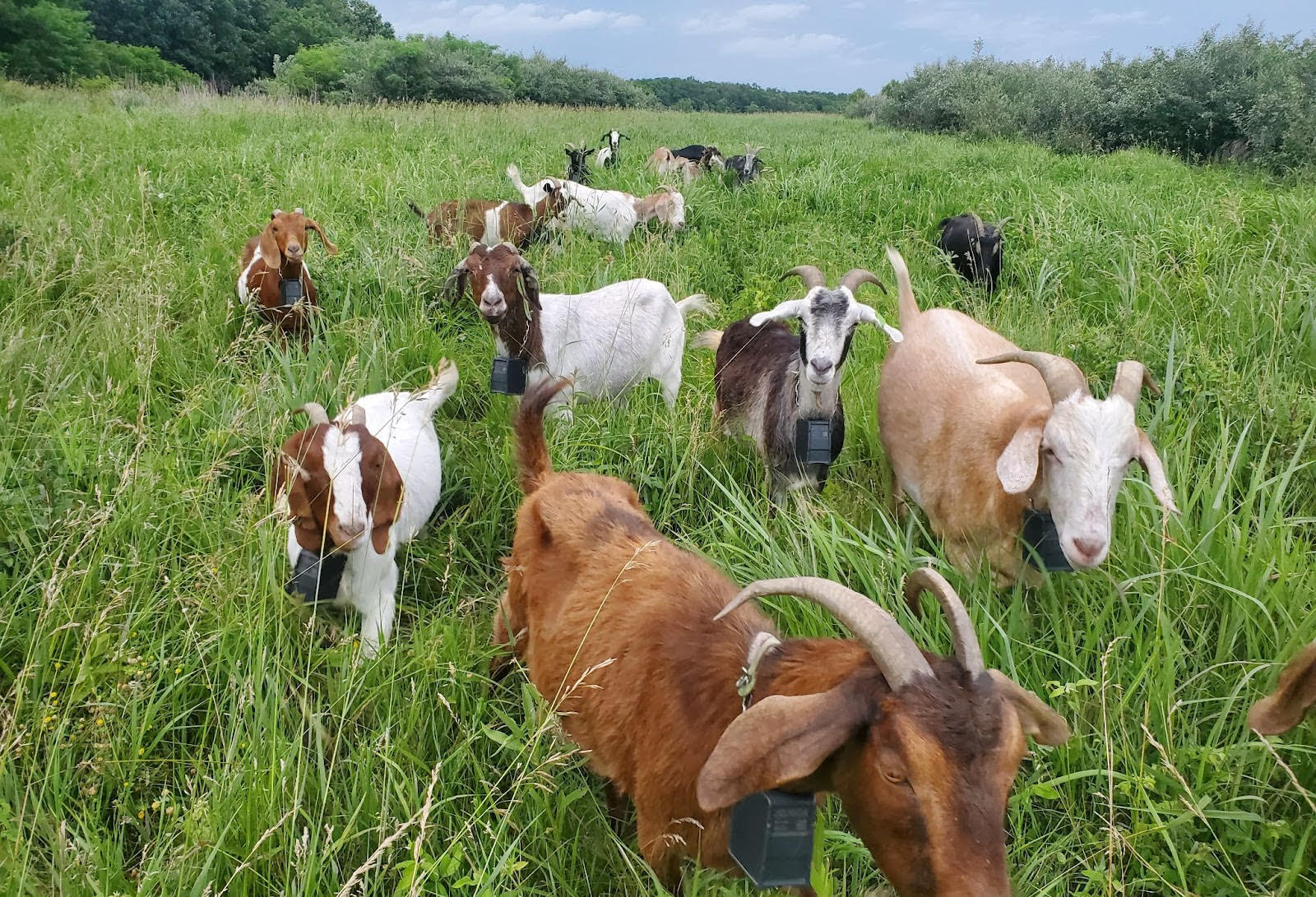
Virtual fencing is another GLBW-backed practice supported by NRCS. Virtual fencing uses GPS and battery-powered collars on livestock, allowing grazing areas to be designed without physical construction, similar to invisible fences for pets. The flexibility, durability, and invisibility of this technology expands options for graziers and causes fewer disruptions to wildlife than traditional fencing. As of fall 2024, NRCS has approved cost-share for virtual fencing through the Fence practice standard (#382) for installations to support farmers participating in Grazing Management Plans (practice standard #528). As state-level NRCS offices adopt the virtual fence option, farmers will be able to apply for support to buy the livestock collars and other virtual fence equipment.
GLBW also supports practices that integrate livestock with other farm activities. These practices, like silvopasture and solar grazing, reduce input and area needs, improve soil health, and help control weeds. While low technology options for livestock integration remain a small portion of the funding pool, the agency has rapidly expanded its silvopasture incentives in recent years and obligated over $2.7 million in payments since 2022 (see https://www.farmers.gov/data/financial-assistance-download). Solar grazing allows farmers to keep land in agricultural production while establishing another income stream through energy generation or land leasing. While OBBBA shortens the timeframe in which producers or developers can install solar panels on farmland and receive tax credits, IRA incentives are still available to projects begun before July 2026 or installed by the end of 2027. USDA also provides loans and grants for solar development on agricultural lands through the Renewable Energy for America Program (REAP).
What’s next?
While funding for CLC is increasing through OBBBA’s codification of IRA Farm Bill funding, NRCS is also supporting initiatives to increase farmer awareness of grazing practices and their incentives. Minnesota NRCS has provided a grant to GLBW and its Midwest Perennial Forage Working Group to inform producers and farm advisors of an array of temporary and targeted grazing practices. Over the next 3 years, the project will train farm advisors and farmers in topics such as virtual fencing, solar grazing, invasive species control through grazing, and cover crop grazing – increasing understanding of practices to better prepare farmers to take full advantage of the upcoming increase in NRCS funding. We are excited for the next stage in our work to establish continuous living cover in the Upper Mississippi River Basin region!
More information:
- GLBW resources on Virtual Fencing and NRCS support
- GLBW resources on NRCS support for Perennial Grains
- GLBW resources on NRCS support for Silvopasture
- GLBW’s Midwest Perennial Forage Working Group
- Kernza.org
Review acknowledgement: Thank you to Dr. Cynthia Bartel for reviewing and providing clarifying edits to the information on the NRCS perennial grain conservation crop rotation practice.
|
|
|